California has been the global hub of entertainment for nearly a century. The infrastructure, crew, and locations continue to provide the best support for television and film production, compared to anywhere in the world. The industry supports well over 700,000 California jobs and contributes an estimated $70 billion to the state’s economy annually.
However, as the industry became more mobile, other states and countries began offering massive incentive packages to lure production projects away from California. The state has lost an estimated $1.5 billion to this “runaway production” over recent years.
In response, Governor Newsom, Senator Ben Allen, and Assemblymember Rick Chavez Zbur announced a proposal in October 2024 to more-than-double the Film & TV Tax Credit Program, from a $330 million investment to $750 million annually. Over the summer, Senator Allen and Assemblymember Zbur helped turn this dream into a reality by finalizing the California Film & Television Jobs Act (AB 1138).

Senator Allen speaks to a crowd on a film set while celebrating the signing of AB 1138.
What AB 1138 Does
AB 1138 modernizes the existing California Film & TV Tax Credit Program to better compete with other incentive programs around the world. It expanded the annual investment from $330 million to $750 million, and provided additional flexibility to allow more projects to take advantage of the investments.
Beyond the increased credit amount, notable improvements include:
- Increasing the base tax credit, from 20% to 35%, while maintaining additional 5% uplifts for productions filming outside the Los Angeles Zone and for qualified wages paid to individuals living and working outside the Zone.
- Supporting new career pathways through incentives to hire trainees without displacing experienced workers.
- Providing more opportunities for indie filmmakers by raising their share of the program from 8% to 10%.
- Lowering barriers to the Soundstage Film Tax Credit Program by eliminating outdated requirements.
- Expanding eligible productions to include animation, reboots, 20-minute television shows, and large-scale competition shows while maintaining the $1 million minimum spending requirement.
Why It’s Needed

Over recent years, California fell behind other jurisdictions that started ramping up their incentive programs to draw in these productions, and the state has lost an estimated $1.5 billion annually to this runaway production. Over 70% of projects that were not approved for a tax credit end up filming out of state, and many others do not bother to apply due to limited funding.
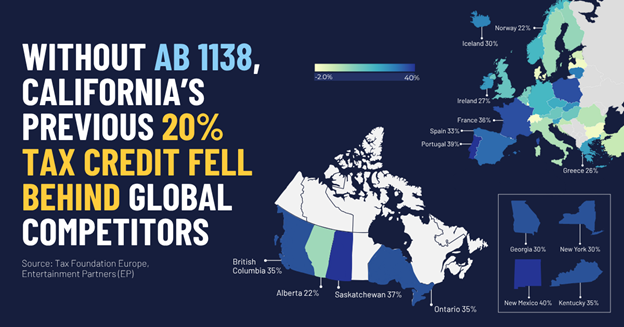
Since the Tax Credit Program was established in 2009, it has operated as a premier economic driver in California, generating over $30 billion in activity and creating 228,000 jobs statewide. However, the recent trends have indicated a need for additional stimulus in order to reestablish a competitive edge and take back market share.
Early Results
The California Film & Television Jobs Act was signed in July 2025 and has provided strong early results. The California Film Commission saw a nearly 400% jump in applications for the first round of credit awards.
Since August, the Commission has approved a total of 39 television projects through the Program. These projects are collectively estimated to generate $2.5 billion in economic activity, including $900 million in qualified wages.
First Round of Television Approvals
Second Round of Television Approvals
The Commission has also approved 80 films that will generate nearly $2 billion in activity, including nearly $1 billion in qualified wages statewide. These projects are estimated to collectively employ 13,700 cast and crew, and an additional 69,000 background performers (measured in days worked).